
· 12 min read
Distillation attacks and your keys on the internet
AI labs are copying each other's models by asking them millions of questions, and someone has to pay for all that. This week the bots behind my edge asked for AI key files 80,377 times, OpenCode's files joined their list 32 hours after the breach, and Monday set a new record.
On Saturday, OpenCode posted this:
We had a security breach last night related to a large scale distillation attack that impacted 1.4% of OpenCode Console users
— OpenCode (@opencode) October 17, 2026
We have notified them all this morning via email. If you did not get an email you were not impacted, it was a subset of users who had external providers…
I've already written about the breach itself: who was hit, the timeline, and what was sitting next to those keys. This post is about the two words most people skipped over: distillation attack.
Here's the short version. Distillation is the reason a stolen AI key is worth money, and it isn't going away. And all week, the bots knocking on the 3,597 websites behind the Mr. Nice Try Edge have been hunting for exactly those keys, harder than ever.
What a distillation attack is
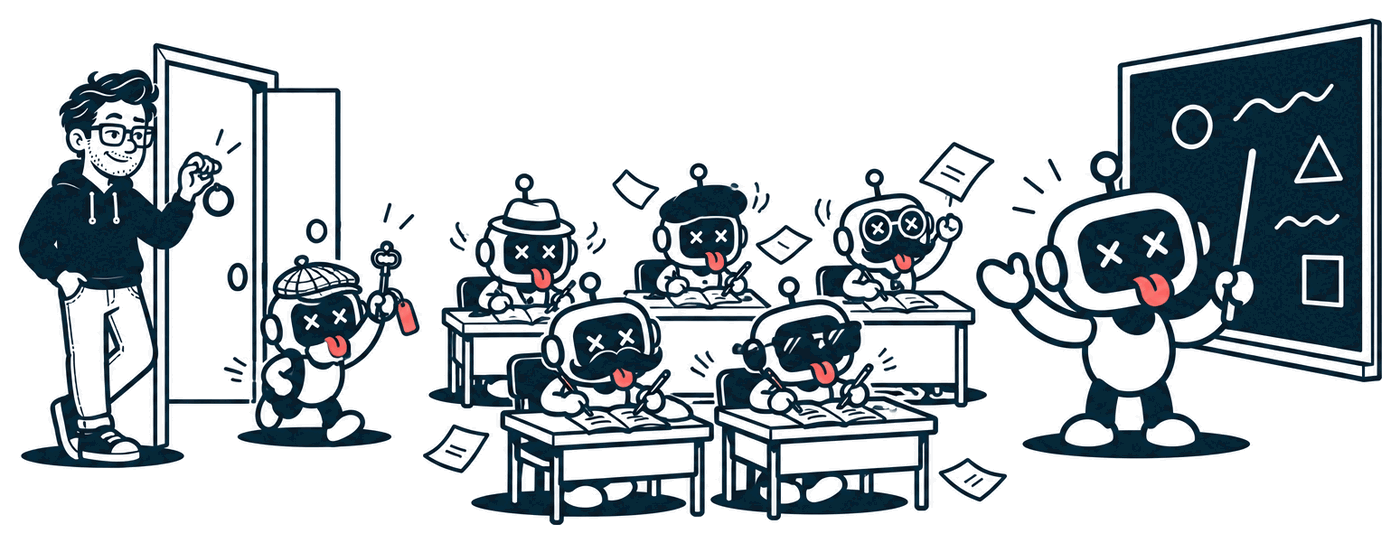
Distillation is training a small, cheap model on a big model's answers. Ask the big model millions of questions, save every answer, and teach your model to answer the same way. It's a normal technique when you do it to your own models. It's called an attack when you do it to somebody else's without permission.
You don't need to break in to do it. You only need two things: a huge number of questions, and an account that will answer them. The labs selling the answers know this, and they've been fighting it all year.
- February: OpenAI told US lawmakers that DeepSeek was distilling its models. Eleven days later, Anthropic named three labs, DeepSeek, Moonshot and MiniMax, that had generated over 16 million exchanges with Claude through about 24,000 fraudulent accounts. Anthropic said they came in through "commercial proxy services which resell access to Claude," and that one proxy network ran more than 20,000 fake accounts at once.
- September: Anthropic's threat report named seven labs in China, Alibaba among them. The same report called out "compromised API keys, session tokens, and devices" as a target for criminal groups. It also described a reseller that sold cheap Claude access, quietly answered with a different model, and harvested its customers' Anthropic credentials.
- October 12: Anthropic said its new defenses had cut the data distillers harvest by "around 90 to 99%," and that it has "resumed charging for requests that are blocked by our safeguards before Claude responds."
- October 17: OpenCode's breach, "related to a large scale distillation attack."
Why it ends with your key
The labs are closing the front door. Fake accounts get banned faster, blocked requests still cost money, and a lab's own sign-up page is the place it watches most closely.
A real developer's key gets around all of that. It's a paid-up account with years of normal history, somebody else's card on file, and no reason for anyone to look at it twice. Spend it until it's revoked, then move on to the next one.
That's my reading, not something any lab has said, but every piece of it is public. The proxies need accounts. Fake accounts are getting harder to keep alive. Anthropic's report describes stolen credentials being sold to resellers that keep swapping in fresh keys until each one runs dry. And if a lab charges for blocked requests, a stolen key used for failed extraction attempts still runs up a bill. That bill goes to the key's owner.
Here's how the chain fits together:
- A scanner finds the key. A
.envfile in a web root, an agent's settings file deployed by accident, a repo, a screenshot, or a tool that kept your key and got breached. - Someone checks it works. In the OpenCode breach, one victim's logs show a prompt meaning "please reply ok," answered "ok."
- It gets sold or pooled. Into a reseller's proxy, alongside thousands of others.
- It gets spent. Millions of tokens, often overnight. One OpenCode victim's key ran 8,966 requests and 35 million tokens in a day.
- You get the bill. Sometimes a refund. Sometimes a suspended account.
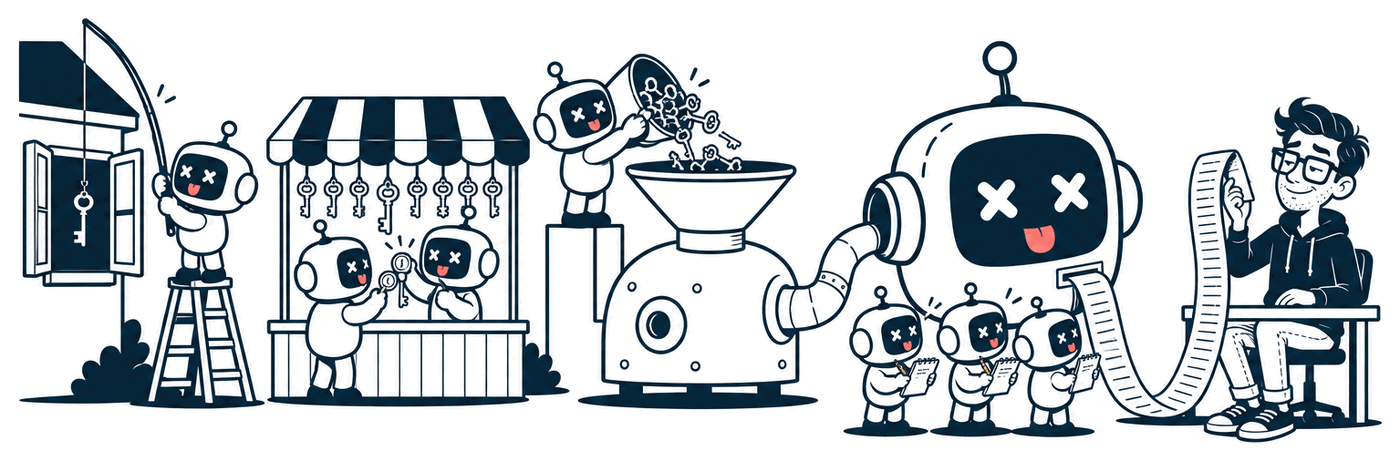
I can't follow one key from my logs all the way to a distillation run. Nobody outside the labs can. But I can show you the first step happening, thousands of times a day.
What the edge saw this week
The Edge sits in front of 3,597 websites and writes down every request. I went through October 13–19 looking for one thing: requests for files that might hold an AI key, or an AI agent's settings. Things like /.env.anthropic, /.claude/settings.json, /config/openai.json and /litellm/config.yaml.
Requests for AI key files, per day
Every site behind the Edge · October 8–19, 2026 (UTC)
On Saturday, the day of the OpenCode breach, it set a record: 17,071. On Monday it nearly doubled that, with 30,106. Here's what's behind the numbers.
Anthropic's keys are the most wanted
| Whose keys | Requests | IPs |
|---|---|---|
| Anthropic, including Claude Code's settings | 48,232 | 110 |
| OpenAI | 22,484 | 103 |
| Google Gemini | 1,915 | 51 |
| AI gateways (OpenRouter, LiteLLM, Ollama) | 1,581 | 11 |
Coding agent configs (MCP, Cursor, Copilot, AGENTS.md) |
1,250 | 60 |
| OpenCode | 991 | 2 |
| Hugging Face | 772 | 323 |
October 13–19, 2026. Each file is counted once, for the first name in its path.
Anthropic beat OpenAI more than two to one. A big part of that is two files: /.claude/settings.json and /.claude/settings.local.json, the settings for Claude Code. Those files can hold environment variables, API keys included, and they live in the project folder. If that folder gets deployed as-is, they're on the internet.
That's the new part. A year ago scanners hunted for keys in your app's config. Now they hunt in your coding agent's config too.
AI keys are on the same checklist as AWS keys
70% of all these requests came from Google Cloud. Not from Google itself: from rented servers on it.
The biggest single source is a fleet of about 60 servers on Google Cloud, 45 of them in the Brussels region. Nearly all of them share one TLS fingerprint and a browser name that's cut off halfway through. Every visit runs the same checklist of dozens of files, and each file was asked for about 13,100 times this week:
/.env,/.env.local,/.env.production,/.env.backupand friends/.git/configand/.git-credentials/.aws/credentials/.env.openai,/.env.anthropic,/.claude/settings.json,/.claude/settings.local.json
AI keys sit on the list right next to cloud keys and git passwords. Nobody had to build a special AI-key scanner. They added four lines to the one they already had.
A second Google Cloud fleet works the other way: 324 IPs, about three requests each, asking for /.cache/huggingface/token and /llm/.env. Spread that thin, no single IP looks like anything. Together they visited 217 sites.
If you saw my post on banning networks, this is why Google Cloud keeps coming up. You can't ban it outright, but almost all of this fleet's traffic came from outside the US.
OpenCode joined the list 32 hours after the breach
OpenCode posted about its breach at 17:56 UTC on Saturday. Until then, the only OpenCode file anyone had asked the Edge for was /opencode.json, the project config: 30 times in a week. Nobody had gone looking for an OpenCode key.
At 01:37 UTC on Monday, 31 hours and 41 minutes later, a server on TC DATACENTER in Hong Kong tried these on two sites:
/opencode-zen/.env
/opencode/.env
/.opencode/auth.json
/.opencode/config.json
/.opencode/settings.json
/lib/opencode.js
/api/opencode/config.js
/services/opencode/index.js
It took four minutes. Then it stopped.
At 22:15 that night its next-door neighbor, one IP over, sprayed the same eight files at 122 sites in 80 seconds. It was in the middle of the attack that cold-booted 926 servers, and I'd missed this part of it. Of that burst's 84,161 requests, 16,848 were for AI keys, across 132 different files: 48 for OpenAI, 42 for Anthropic, 9 for gateways like OpenRouter and LiteLLM, 8 for OpenCode and 5 for Gemini.
/opencode-zen/.env isn't a real file. Zen is OpenCode's paid service, and nobody keeps a .env named after it. Somebody read the news, guessed where an OpenCode key might live, wrote eight guesses down, tested them, and shipped them, all in under a day and a half.
That's how fast a headline becomes a wordlist. When a tool that holds keys makes the news, assume its files are being looked for by the next day.
Sometimes they don't need a key at all
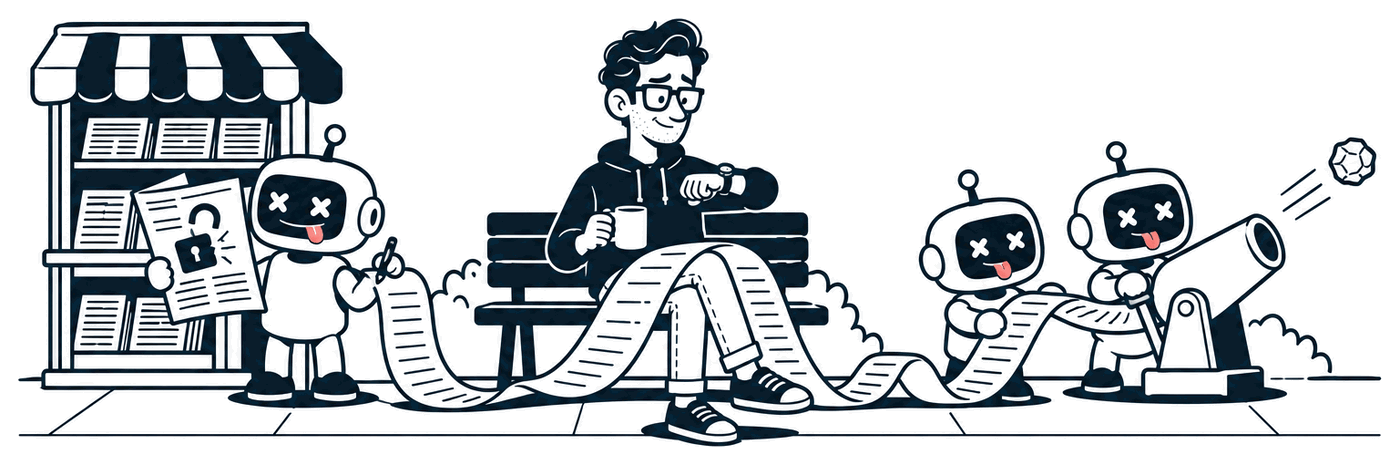
The other half of the hunt doesn't look for keys. It looks for an AI that will answer without one.
- One IP on TECHOFF SRV sent 756
POST /v1/chat/completionsrequests to 133 sites. That's the address of any OpenAI-compatible API: OpenAI itself, a LiteLLM proxy, a self-hosted model. If any of those sites had answered, it would have had free AI on someone else's bill. - An Azure server in India did the same to 74 sites, with the same client:
Python/3.12 aiohttp/3.9.1. - Datacamp servers located in Ukraine asked
/v1/modelsand/v1/chat/completionson dozens of sites, without even sending a browser name. - Others asked for
/api/tags,/api/generateand/api/ps: an Ollama server's addresses, in case someone left one open to the world.
Not one of them got an AI to answer. But think about what they're after. An open AI endpoint is a free key that never gets revoked.
What they got
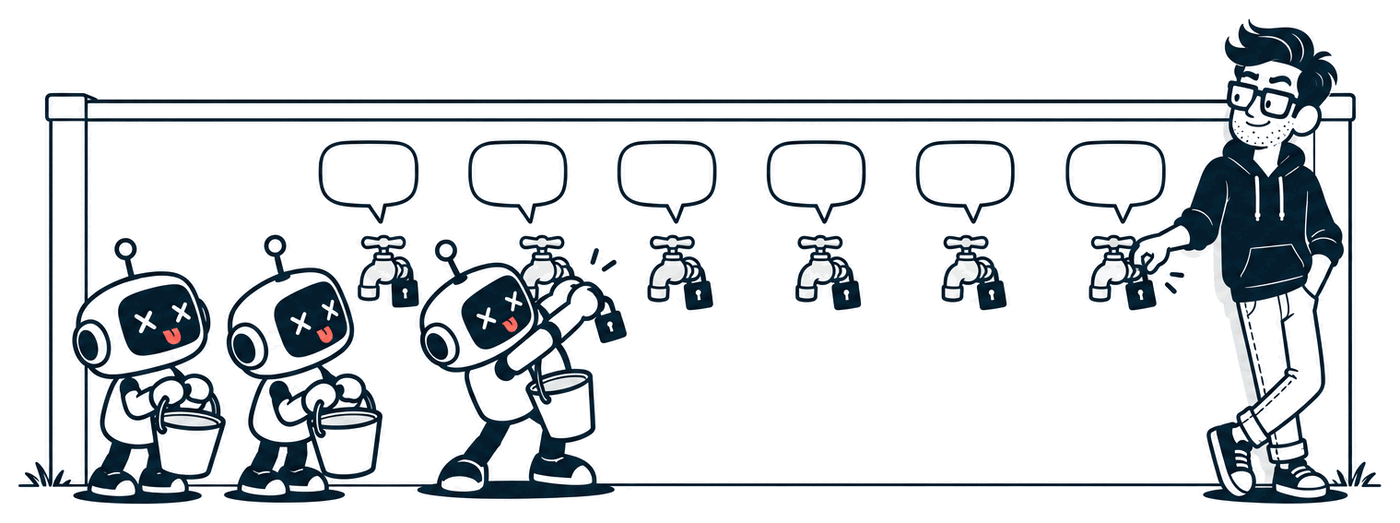
Nothing worth having, as far as I can see. 98% of those 80,377 requests got a 404, or a 429 telling them to slow down. The rest were redirects, catch-all pages and errors.
But they don't need a high hit rate. They need one key, once. Running the checklist costs them almost nothing. That math only works because somewhere, every day, it does pay off.
What to do about it
None of this is new advice. It's just that the keys are worth a lot more than they used to be.
Keep keys out of anything a web server can serve
Your web root should be one folder that holds only public files. If you use Laravel or Rails, that's public/, and .env lives one level up. If you deploy a whole project folder, everything in it is a URL.
Then block the obvious ones at the server anyway. In nginx:
# Dotfiles (except .well-known), .env files of any name, and agent notes
location ~ (/\.(?!well-known/)|\.env(\.|$)|/(AGENTS|CLAUDE)\.md$) {
    return 404;
}
In Caddy:
@secrets {
    path_regexp (/\.[^/]|\.env(\.|$)|/(AGENTS|CLAUDE)\.md$)
    not path /.well-known/*
}
respond @secrets 404
Don't ship your agent's settings
Add these to .dockerignore, and to whatever your host uses to decide what gets uploaded:
.env*
.claude/
.cursor/
.codex/
.opencode/
.continue/
mcp.json
Coding agents save settings in your project folder because that's convenient. It's also how they end up in production.
Give every key a small blast radius
- One key per app or tool. When one leaks, you revoke one key and nothing else breaks.
- A hard spend limit on every key, plus an alert well below it. A distiller can empty a big balance overnight. Make the balance small.
- Rotate keys you saved in tools you've stopped using. OpenCode's breach hit a legacy system that was being shut down. Old tools still hold old keys.
- Revoke at the provider. Deleting a key from a tool doesn't kill it. Only OpenAI, Anthropic, Google or OpenRouter can.
Never leave an AI endpoint open
If you run a LiteLLM proxy, set a master key. If you run Ollama, keep it on 127.0.0.1 (the default), or put something that checks a password in front of it. Assume any address on the internet that speaks /v1/chat/completions will be found within days.
Treat the first ask as a confession
Nobody with good intentions asks your website for /.env.anthropic. Not a customer, not a search engine, not a monitor. Whoever asks is telling you exactly what they're there for. Block them on the first request, and keep blocking them.
The fight is between labs. The bill isn't.
Distillation is a fight between AI labs: who gets to learn from whose model, and what it costs. The labs are getting better at stopping it. Anthropic says its new defenses cut what distillers harvest by 90 to 99%.
That's good news, and it pushes the cost onto everyone else. Every door a lab closes makes a real developer's key worth more. The scanners have noticed. This week they asked for AI keys 80,377 times on the sites behind my edge alone, added a breached tool's files within a day and a half, and set a new record on Monday.
Keep your keys out of reach, keep your limits low, and when a tool you use makes the news, rotate first and read the details later.
How I put this together
The traffic numbers come from the Mr. Nice Try Edge's request logs for 3,597 websites, October 8–19, 2026, UTC. A request counts as an AI key hunt if its path names an AI provider, gateway or coding agent (OpenAI, Anthropic, Claude, Gemini, OpenRouter, LiteLLM, Ollama, MCP, Cursor, Copilot, OpenCode, Hugging Face and about two dozen others). I matched whole words only, so a random token that happens to contain "xai" doesn't count. That list is a bit wider than the one in the daily reports, which is why Saturday's count here (17,071) is a little higher than the one I gave before (16,813). Network names come from each IP's ASN, and the Google Cloud regions from IP location data.
The lab and breach details come from the sources linked above. Where I'm inferring, such as stolen keys becoming more valuable as labs shut out fake accounts, I've said so.
References
- OpenCode: the post, and my breach write-up
- Coverage: The Hacker News, BleepingComputer
- Anthropic: Detecting and preventing distillation attacks (February 23), September threat report, Strengthening our defenses against distillation attacks (October 12)
- OpenAI and DeepSeek: Bloomberg (February 12)
- Seven labs named: The Hacker News